The Phantom Arabesque: Rolls-Royce's Dubai-Commissioned Tribute to Mashrabiya Craft
A Bonnet Engraved, Not Painted
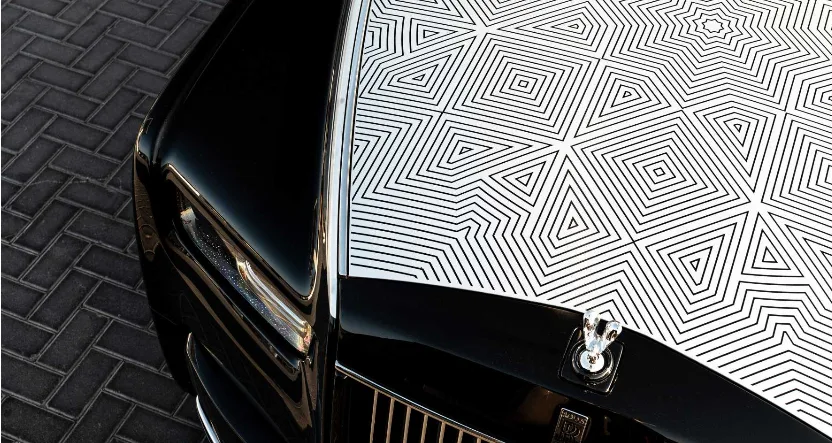
Rolls-Royce has delivered the Phantom Arabesque, a one-of-one Phantom Extended commissioned through the marque's Private Office Dubai for a client from the region. Its centrepiece is the first laser-engraved bonnet Rolls-Royce has ever produced: a mashrabiya-inspired lattice pattern, drawn from the wooden latticework screens found across traditional Middle Eastern architecture, engraved directly into the paintwork to a depth of 145 to 190 microns. The result reveals a darker tone beneath the surface and creates a genuinely three-dimensional finish that shifts as the light changes across it — not an applied graphic or a wrap, but a texture cut into the car itself, panel by panel, on the finished bonnet.
The technique took five years to develop at Rolls-Royce's Exterior Surface Centre, which says something about how deliberately the marque now treats its most significant regional commissions — this isn't a quick special-edition trim package, but a genuinely new manufacturing process brought into being for a single car. The rest of the exterior carries the same restraint: a two-tone finish pairing Diamond Black with contrasting Silver upper surfaces, a single hand-painted coachline continuing the mashrabiya motif around the body, an illuminated Pantheon Grille, and 22-inch part-polished alloy wheels. Inside, the Gallery — the dashboard fascia unique to Phantom, traditionally reserved for a client's own choice of art or material — holds a bespoke marquetry artwork in Blackwood and Black Bolivar wood echoing the same lattice geometry, framing an offset clock, with the mashrabiya pattern embroidered again into the front and rear headrests against Selby Grey and Black leather.
Why the Commission Went Through Dubai
What's worth noting isn't just the craft, but where Rolls-Royce chose to debut it. A five-year-in-development, first-of-its-kind engraving technique didn't premiere through a European atelier — it was commissioned and delivered through Private Office Dubai, for a client based in the region. That's consistent with a pattern that's been building for a while: the GCC isn't treated by these marques as a secondary market absorbing standard-specification cars shipped over from Europe, it's increasingly where the most ambitious bespoke work actually originates. Buyers here are commissioning pieces that reference their own architectural and cultural heritage directly, rather than choosing from a European catalogue of options, and the manufacturers are building the in-region capability — private offices, dedicated commissioning teams — to meet that brief properly.
Commissions like the Phantom Arabesque are a useful reminder of how wide the gap can be between two cars that share a model name on paper. A one-off Phantom with a patented, five-year engraving process and a fully documented commissioning history is a fundamentally different asset than a standard-specification example — in rarity, in story, and eventually in value.